
New Jersey Keeps Winning: January 2025 Revenue Breakdown
New Jersey is not slowing down. The Garden State’s gambling market posted another month of impressive revenue figures in January 2025, reinforcing its position as the most closely watched benchmark for regulated iGaming and sports betting in the United States. For analysts, operators, and regulators alike, New Jersey gambling revenue is the canary in the coal mine – when it rises, the entire US market pays attention.
January is historically a softer month for gaming. The post-holiday hangover, tighter consumer budgets, and fewer marquee sporting events typically drag numbers down. Which makes this performance all the more telling.
- New Jersey gambling revenue rose year-over-year in January 2025, defying typical seasonal softness.
- Online casino (iGaming) continues to be the dominant growth engine, outpacing retail and sports betting in momentum.
- Online sports betting remained robust, buoyed by NFL playoff action and sustained user acquisition from operators.
- Retail casino performance at Atlantic City properties showed mixed signals, reflecting a structural shift in player behavior toward digital channels.
- New Jersey remains the US iGaming blueprint, with its regulatory framework increasingly cited as a model for emerging states.
The Numbers That Matter
While the full granular figures are sourced directly from the New Jersey Division of Gaming Enforcement (DGE), the headline trend is clear: total gross gaming revenue (GGR) moved upward on a year-over-year basis. That consistency is no accident. It is the product of a mature, well-regulated market firing on multiple cylinders simultaneously.
Online Casino GGR: The Undisputed Star
Online casino revenue – the segment tracking slots, table games, and live dealer products offered through licensed platforms – continues to post the most compelling growth curve in the state. iGaming GGR in New Jersey has now maintained a sustained upward trajectory that few markets globally can match at this stage of maturity.
The key drivers are structural, not cyclical. New Jersey benefits from a deep roster of licensed operators including BetMGM, Caesars Palace Online, DraftKings, FanDuel, and Golden Nugget Online Gaming, all of whom continue to invest aggressively in product development, game content acquisition, and promotional spend. The competitive density keeps acquisition costs high but also forces constant product improvement – a dynamic that ultimately benefits the player and sustains engagement.
Analyst’s Note: New Jersey’s iGaming GGR is now large enough that its year-over-year comparables are genuinely difficult to beat. Sustained growth in this environment signals real market expansion, not just base-effect inflation. This is organic demand.
Online Sports Betting: Playoff Season Does the Heavy Lifting
January 2025 carried a powerful tailwind for online sports betting: the NFL playoffs. The postseason is the single highest-handle period in the American sports betting calendar, and New Jersey’s licensed sportsbooks captured their share of that action. Handle – the total amount wagered before payouts – almost certainly hit elevated levels, though GGR as a percentage of handle fluctuates based on outcomes that favor bettors or the house in any given week.
The structural story here is operator consolidation. FanDuel and DraftKings command the majority of market share in New Jersey’s online sports betting segment, and both have demonstrated sophisticated retention mechanics – same-game parlays, live betting interfaces, and loyalty integrations – that keep monthly active users engaged beyond the initial acquisition phase.
Atlantic City Retail: Structural Headwinds Persist
The nine operating casinos on the Atlantic City Boardwalk and Marina District tell a more complicated story. Retail gaming revenue faces a dual squeeze: the ongoing cannibalization from online channels and broader regional competition from Pennsylvania, New York, and Connecticut, all of which have expanded their own gaming footprints in recent years.
That said, Atlantic City is not collapsing. Non-gaming revenue streams – hotel occupancy, entertainment, food and beverage – continue to support property-level economics even as slot and table game volumes face pressure. The casinos that are winning are those that have leaned into their online affiliates, using retail properties as brand anchors rather than sole revenue centers.
Why New Jersey’s Model Works
New Jersey legalized online casino gaming in 2013, making it one of the earliest adopters in the US. Over a decade later, that head start is measurable in market maturity, regulatory sophistication, and operator trust. The DGE runs one of the most transparent and data-rich regulatory regimes in the world, publishing monthly revenue reports with the granularity that analysts need to make informed market assessments.
The Regulatory Framework as Competitive Advantage
New Jersey’s licensing structure requires operators to partner with Atlantic City casino licensees – a so-called tethering requirement – which has historically kept bad actors out while ensuring that online revenue benefits brick-and-mortar properties through revenue sharing. This dual-channel model has proven remarkably durable.
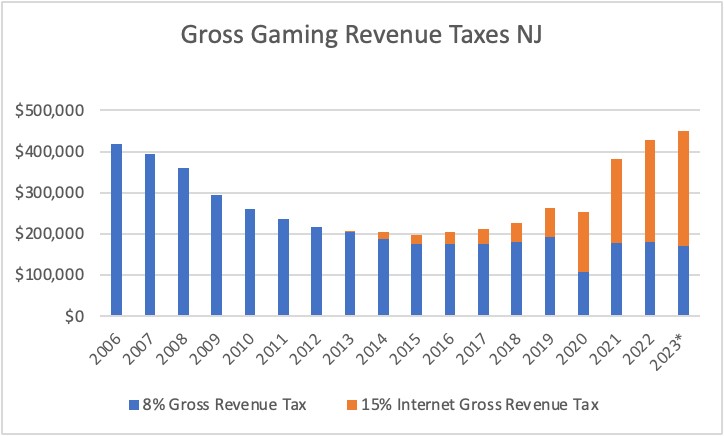
Tax rates on iGaming GGR sit at 15% for online slots and 15% for online table games and poker, with an additional 2.5% investment alternative tax. These rates are competitive enough to attract serious operators while generating meaningful state revenue – a balance that states like Illinois and New York are still struggling to find as they implement their own frameworks.
Pro Tip: If you are tracking which US states are likely to legalize iGaming next, study New Jersey’s regulatory architecture closely. The states that model their frameworks on New Jersey tend to launch faster and attract more credible operators from day one.
The Broader US iGaming Context
New Jersey does not exist in a vacuum. Its January 2025 performance lands in the context of a US iGaming expansion story that is accelerating nationally. Michigan, Pennsylvania, Connecticut, Delaware, West Virginia, and Rhode Island all operate legal online casino markets, and several additional states are in active legislative consideration.
The critical insight from New Jersey’s data is that iGaming and sports betting are not cannibalizing each other – they are growing in parallel. Players who engage with online sports betting frequently cross over to online casino products, and vice versa. This cross-sell dynamic is what makes the integrated operator model, championed by companies like Flutter Entertainment (FanDuel), MGM Resorts (BetMGM), and Caesars Entertainment, so strategically powerful.
What January Tells Us About 2025
A strong January, even accounting for NFL playoff tailwinds, sets a meaningful baseline for the year ahead. If New Jersey sustains year-over-year growth through Q1 and into Q2 – months that lack major sporting calendar catalysts – it will signal that the iGaming segment has achieved genuine self-sustaining demand independent of external event drivers.
Watch for the March numbers specifically. March Madness is the second-biggest sports betting event after the Super Bowl, and it overlaps with a period of high online casino engagement. How operators manage that dual opportunity will say a great deal about their product sophistication heading into 2025’s second half.
The Bottom Line
New Jersey’s January 2025 gambling revenue report is more than a monthly data point – it is a confidence signal for the entire US regulated iGaming ecosystem. Online casino continues to demonstrate that it is a structural growth market, not a pandemic-era anomaly. Sports betting is maturing intelligently. And Atlantic City, while navigating real headwinds, is adapting rather than retreating.
For operators, the message is straightforward: invest in retention, not just acquisition. New Jersey’s market is too competitive and too sophisticated for churn-and-burn user economics. For regulators in emerging states, the message is equally direct: New Jersey’s framework works. The data proves it, month after month.
And for the US iGaming market at large, New Jersey in January 2025 is exactly the kind of benchmark it needed: steady, growing, and built to last.